In my previous article, I discussed the three Illusions of Usability: focusing on an attractive tool interface, designing the tools for a limited range of tester personas, and neglecting to support change and growth. Picking up one of those illusions, it became clear that people building and selecting tools to support testing (TtST) find it hard to answer the question: “who is this for?” and that help to understand tester personas could be helpful. I set out to find out “who is testing?” and as before with this research adventure, the answer surprised me. I began to realise why tester personas are hard to define, and that they are not necessarily aligned to job titles.
- Testers are not stereotypical IT people—and that is a benefit to us all;
- Testers’ degree subject seems to correlate with their communication style and preferred approaches but not with successfully holding a technical role;
- This has implications for society, building testing skills in teams, and work practices.
This research was done through a survey of over 70 industry practitioners, who anonymously answered open questions about their backgrounds, roles and work practices. I’ve published the method and results in presentations, papers and an article in the BCS HCI Journal; look there for the specific detail of results, references to related studies, and other evidence. In this article I will introduce the key findings and why they matter.
Testers Are Not Stereotypical IT People—A Benefit to Us All
Stereotypes about IT people, specialist testers, and the activity of testing, are held by academics, industry recruiters, managers and practitioners. Academic studies by computer scientists often focus on unit testing, automation, and testers as software engineers. Academic studies by HCI specialists focus on testing as an activity performed by end users and observed by HCI specialists. Industry recruitment databases hold a stereotype of IT people avoiding social interactions, with little interest in the arts, and having a small number of hobbies.
Recruitment characterisation, and the views of people not already in a testing role, additionally see testing as a boring repetitive activity, done by boring people, and requiring a conscientious attention to details. In contrast, people who are already in a testing role discuss their challenges, the variety of activities, the need for critical thinking, and the importance of communication.
Additionally, industry surveys of managers up to C-level showed the organisations’ leaders wanted critical thinking, problem solving, flexibility. They require the ability not just to automate unit tests, or observe end users. They require organisational and system wide understanding of quality, risk and opportunity.
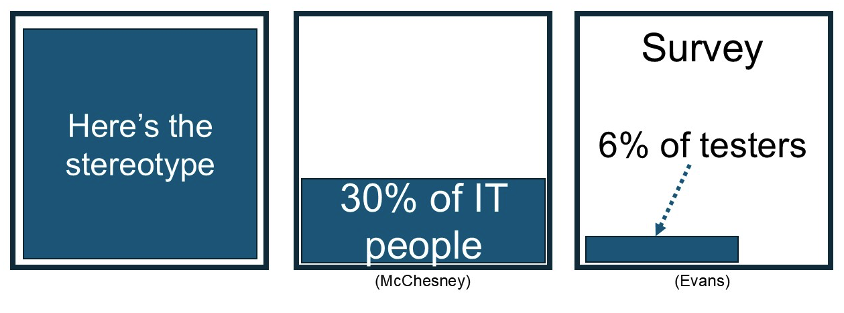
One stereotype of IT people is that their interests are individual, STEM, indoor, passive, and that individuals have a low number of interests. I had seen a paper which compared this stereotype with 1000 IT practicing and aspiring IT professionals; they found only around 30-40% of IT practitioners and aspirants met this stereotype; the majority of IT people are not stereotypical.
I repeated their analysis with the data from my survey: When I looked at the pattern of interests in the survey of testers, 90% had arts hobbies or interests, 45% had arts hobbies that were active in making, performing, writing, playing instruments, singing in choirs. Many had a wide range of interests (in the schematic in Figure 2 you can see the percentages add up to far more that 100%).
Many were engaged in interests that were highly social, involving teams, groups and friends. Only 6% of the testers in my survey were stereotypical, so 94% were not stereotypical, and perhaps would not have been identified in a recruitment process using that database as potential testers.
Figure 1: Only 6% of testers met the recruitment stereotype of an IT person
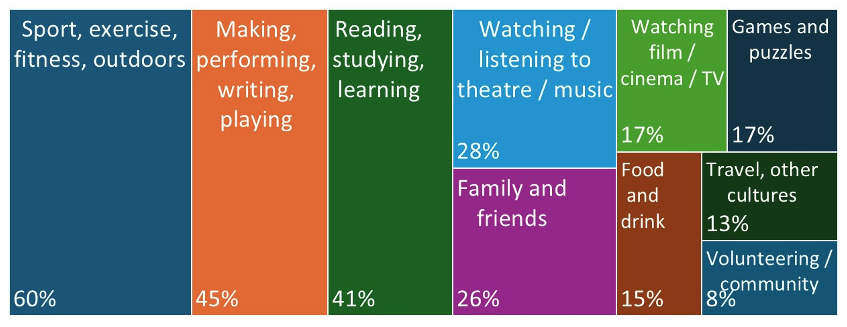
Figure 2: Hobbies and Interests
The IT professionals in McChesney's sample and the testers in my survey, are closer to the general population in outlook, interests and behaviours than the IT stereotypes held by academics and recruiters would indicate. This has to be a benefit, as it means that there is likely to be an increased understanding, representation and championing of the needs of people across society. As software systems are now ubiquitous and with the increase in use of AI, this representation is more important than it has ever been. The recruitment stereotypes reinforce a narrow recruitment to IT, with the potential for an industry that neither understands nor empathises with its customers.
Testers Come from a Wide Range of Backgrounds—A Benefit to Work Practices
The academic stereotype of testers expects them to be software engineers, but the participants in the survey did not adhere to that stereotype. Only 16% said they had IT related degrees. Arts, social sciences, sciences were all represented, with 18% of participants not having a degree, and another 18% not mentioning their degree.
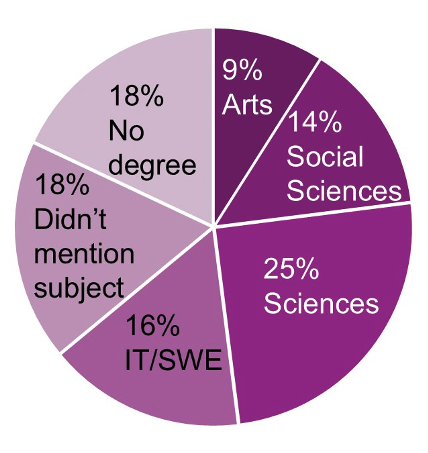
Figure 3: Degree Subjects: 9% Arts, 14% Social Sciences, 25% Sciences, 16% IT/SWE, 18% subject not known, 18% no degree
There has been discussion over the years about whether testers should have greater technical skills, be adept at coding, and perhaps always be software engineers—a topic explored in depth in John Stevenson's StickyMinds piece, The Role of Testers in an Agile Environment. It has been suggested that this would make testers more able to use TsST. However, research about developers’ experiences show coding ability did not predict success with the developer toolset. Of course, there are advantages to knowing something about coding, one is more able to communicate with developers about their challenges, and more “T-shaped” when part of cross-functional teams.
What one participant referred to as ‘roles outside tech’ can bring obvious and less obvious skill sets and knowledge. Math, applied science, engineering, electronics, and electronic engineering are clearly related to IT, and clearly bring technical skills and knowledge that can be applied in testing. Other skills and knowledge are also useful to enhance testing, and the interaction of the tester with other people in and around the IT project. Multi-country, multi-cultural projects benefit immensely from this mix. Backgrounds ranging from business domains (HR, marketing) to communication fields, critical-thinking disciplines (philosophy, medicine), and craft practices (carpentry, theatre) provide teams with unique problem-solving lenses and resilience.
I also looked at the communication styles compared with the degree subjects. I noticed their communication styles often aligned with their subject.I looked for indicators such as length of sentences, use of bullet points, use of storytelling, and what the participants felt was important to share in their responses. Technical graduates favored terse, process-focused lists, while arts and non-degree paths favored expansive, contextual storytelling—both of which are needed to balance a team. These latter also mentioned team working, organisational systems thinking, showing interest not just in software but in its context and consequences.
Does this difference in communication style affect how people carry out their testing roles? Is there a benefit in having adept communicators in testing roles? Communication was raised by survey participants as critical for software testers because their roles require communication across organisations, echoed in the same year by prominent industry publications. Communication is a key part of the testing activity, both listening to and providing information to people in many roles inside and outside the IT project. When the participants described their roles, 27% of the responses were related to communication, people and management, with a high frequency of words such as listen, talk, support, inspire, mentor, coach, teams, schedule, plan, manage. Key techniques used in testing, such as pair and ensemble testing are enhanced by good communication.
Technical skills, coding, and the like can be taught, and indeed, research has shown that learning programming may be supported more by a facility for languages than by a facility for maths. Recruiting people from a wide range of backgrounds is beneficial to testing activities and the success of projects.
Degree subject appears to not be a predictor of the role within testing that a person is suitable for; 42% of the IT/SWE graduates were not in technical roles, while around 40-45% of the others had technical roles. Many of the participants mentioned that their roles were complex and multifaceted; they 'wear a lot of hats,' in the words of one, while some queried whether their job title met the actual role they had “Every test specialist in the company is called a QA engineer, but with different actual focus.”
Comparing data from the earlier surveys with this survey shows that job titles are changing, but not necessarily the content of the roles. For example, coaching is now an acknowledged rather than “side of the desk” activity. Aspirations ranged widely: some were content in current roles,while others expressed higher ambitions. IT career progression models for testers can sometimes be limited.
Current IT career frameworks often cap technical testing roles prematurely, failing to account for the C-level leadership aspirations uncovered in the research, which take testing as part of quality engineering to the highest level of responsibility in the organisation. This is a possible pointer to updating career progression frameworks, and reflects the call in recent industry reports for people in testing and quality roles to step up to organisational wide influence.
Testers Are Different—and This Matters
It looks like testers are different. They deviate from the recruitment stereotype and from the academic stereotype. They are diverse in origin and in the range of tasks they perform day-to-day. Roles are changing—to SDETs, to Quality Engineers and other job titles, but still the type of work—questioning, analysing risk, providing information—both requires and attracts a wide range of people into the role. Diverse backgrounds—philosophy, theatre, HR, and carpentry—bring valuable skills: critical thinking, communication, domain knowledge, patience, and attention to detail.
Testers are more artistic, socially engaged, and multi-interested than the stereotypical IT worker, promoting empathy across society.Their hobbies reflect collaborative working—relevant for modern practices of pair testing and ensemble works. Continuing to support diversity of people in your teams is healthy for your organisation, customers, users, and society.
What You Can Do
When you are building your teams, think about recruitment beyond your current preferred backgrounds for candidates. For onboarding, training, and retention of staff, think about how to build communication as well as technical skills across the staffing of your teams. Consider the aspirations of those who specialise in testing and quality roles, and how those aspirations can be supported by career paths to the highest levels in your organisations.
Next Article
We’ve seen that testers are clearly diverse in backgrounds, education, hobbies, and communication styles. Simple persona sets cannot capture this complexity. In the next article, I will show the idea-t framework, a set of 12 heuristics, built from research evidence which help people choosing or building tools think about who will use them.
Terms
- HCI Human-Computer Interaction—the academic field that studies how people use technology, and how to design it better for them.
- Persona A fictional but realistic profile of a typical user, built from research data, used in design to represent a group of real people.
- Stereotype A simplified, often inaccurate, assumption about what a group of people is like—in this case, assumptions about who works in IT.
- TsST Tools to Support Software Testing—any tool used in testing activities.
- idea-t "Influencing the Design, Evaluation and Acquisition of Tools for Testing"—the framework of heuristics developed from this and related research.





Lets Hang!