Your AI agent sailed through every evaluation. It answered questions correctly, called the right APIs, and completed every test scenario without a single error.
Then you deployed it.
Within days it was freezing mid-task during peak hours, silently corrupting records after an API timeout, and producing outputs no one could explain or audit. Sound familiar?
This is a pattern playing out across enterprise teams right now, and it happens for one reason: we are still testing agents like chatbots. But tool-calling AI agents are not chatbots. They plan multi-step workflows, invoke external APIs, maintain state across turns, and produce real-world side effects: creating records, triggering transactions, sending notifications.
Evaluating whether the model gave a plausible answer tells you almost nothing about whether the agent holds up when 200 people use it simultaneously, or when an upstream API goes dark mid-task.
Why Prompt-Response Testing Is Not Enough
Traditional LLM evaluation asks one question: did the model produce a correct output given this input? That is the right question for a stateless chatbot. For a production agent, it is the wrong question entirely.
Here is what single-run, prompt-response evaluation cannot detect:
- Concurrency failures. An agent that succeeds when one tester submits a query may stall or degrade when 200 employees use it simultaneously.
- Silent tool failures. If an upstream API times out, does the agent retry gracefully, fall back to cached data, or silently abandon the task?
- Schema drift. When an external API changes its response format, does the agent detect the mismatch or proceed with corrupted data?
- Cost escalation. Token usage can grow unboundedly as context windows accumulate. A single-run test will never surface this.
- Audit gaps. Can you trace every tool call and explain why the agent made each decision? Without structured observability, the answer is usually no. That is a compliance problem, not just a debugging inconvenience.
These are not edge cases. They are the normal operating conditions of any production system. The gap between what current testing measures and what enterprises actually need is a real deployment risk.
Why Agent Testing Is Now a QA Responsibility
AI agent failures are not limited to model quality. They affect release confidence, data integrity, compliance, customer experience, and operational stability. That places agent testing directly inside the QA function, not only inside the AI or platform team.
QA teams do not need to own every part of the agent architecture, but they do need to define what production readiness means. That includes validating outcomes, tool behavior, failure recovery, performance under load, and auditability before the agent is trusted with real workflows.
The teams best positioned to do this are the ones who have always owned production quality signals: QA. The methods and mindset already exist. What is new is the class of systems those methods now need to cover.
Five Areas QA Teams Should Validate
A production-ready agent evaluation model needs to cover five distinct failure classes. Weak coverage in any one of them is enough to cause a production incident.
1. Goal Correctness
Does the agent actually achieve what it was asked to do—not just execute the right sequence of steps, but produce the correct real-world outcome?
Watch for goal drift—when the agent loses track of its original objective mid-execution because the context window fills up. A customer support agent processing a subscription downgrade might complete every step but apply the wrong pricing tier if intermediate context crowds out the original instruction. Success rate alone will not catch this.
Key metrics: Task success rate, end-state correctness (validated against a known ground truth), goal drift rate across repeated runs
2. Tool-Call Reliability
Are the agent's API calls well-formed, correctly targeted, and resilient to upstream variability?
In this context, a tool call is any external action the agent takes, such as querying an API, searching logs, updating a record, or triggering a workflow.
A particularly insidious failure mode is schema drift: an upstream API changes its response structure without notice, and the agent continues operating on stale assumptions. The result is silent data loss rather than an explicit error, which is the kind of bug that surfaces in a customer complaint, not a test report.
Key metrics: Tool selection accuracy, schema error rate, invalid tool-call rate, retry count per task, duplicate invocation rate on non-idempotent operations
3. Performance Under Load
Does the agent maintain acceptable latency and throughput when multiple sessions are active concurrently? Single-run latency numbers are almost always optimistic.
An enterprise knowledge agent expected to serve hundreds of concurrent users must be validated under that load profile, not just when a single evaluator submits a test query in a quiet staging environment.
Key metrics: p95/p99 end-to-end task latency, requests per second, token usage per task, cost per successful task, SLO breach rate under concurrent load
4. Fault Tolerance and Recovery
When things go wrong—and they will—does the agent detect the failure, apply backoff, and recover without human intervention or data corruption?
Fault tolerance testing requires deliberate fault injection: simulate API timeouts, rate limits, partial responses, and dependency outages. For each scenario, define the expected behavior and verify it holds across at least 30 repeated runs to account for LLM non-determinism.
Key metrics: Recovery success rate across fault-injected runs, fallback success rate, mean time to recovery at the task level, human escalation rate under fault conditions
5. Observability and Auditability
Can you trace every decision the agent made, every tool it called, and why? An agent that performs correctly in aggregate but leaves no traceable decision path is a compliance and debugging liability.
This dimension is foundational: without structured observability, you cannot diagnose failures in the other four areas. Collecting traces is necessary but not sufficient. You need to verify that traces are complete, structured, and sufficient for audit purposes.
Key metrics: Trace completeness (% of task executions with full distributed trace coverage), decision-path coverage, audit log retention compliance
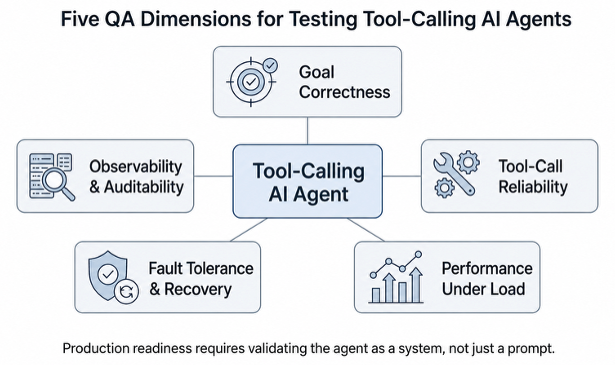
Figure 1: Five QA Dimensions for Testing Tool-Calling AI Agents
A Production Readiness Checklist for QA Teams
Before signing off on any production agent deployment, work through this checklist:
Goal Correctness
- Does the agent produce a correct end-state—not just execute the right sequence of actions?
- Has goal drift been tested by running long multi-step tasks where intermediate context is substantial?
- Are irreversible actions (deletes, transactions, notifications) gated on explicit confirmation?
Tool-Call Reliability
- Has tool selection accuracy been measured across representative task types?
- Has schema validation been tested with intentionally malformed or schema-drifted responses?
- Are retries bounded, and is idempotency verified for non-safe operations?
Performance Under Load
- Has p95/p99 latency been measured under the expected concurrent session count—not just single-user?
- Has token usage per task been profiled across context accumulation scenarios?
- Is there a defined SLO, and has it been validated under realistic load?
Fault Tolerance and Recovery
- Have timeout, rate-limit, schema-drift, permission-denial, and dependency-failure scenarios been injected?
- Does recovery success rate meet the defined threshold across a minimum of 30 repeated runs?
- Is human escalation triggered correctly when all retries are exhausted?
Observability and Auditability
- Is distributed trace coverage complete—every tool call, every planning step?
- Are decision-path logs sufficient for post-incident root-cause analysis?
- For regulated workflows, has the audit trail been reviewed against compliance requirements?
Example: Testing an L1 Support Triage Agent
Consider an L1 support triage agent that receives an incoming support ticket, queries the knowledge base for matching resolutions, checks the customer's account history and entitlements, classifies the severity and category, and either resolves the ticket automatically or routes it to the appropriate human queue.
Here is how each validation dimension applies:
- Goal correctness: Does the agent resolve the right tickets automatically and route the ones it should not handle? A high auto-resolution rate means nothing if the agent is closing tickets that needed human review.
- Tool-call reliability: Does it query the knowledge base before checking account history, in the right sequence? Does it handle a stale entitlement record without corrupting the ticket classification?
- Performance Under Load: A support SLO of two minutes means nothing if the agent meets it for one ticket but takes six minutes when fifty arrive simultaneously during a product outage.
- Fault tolerance: When the knowledge base API is temporarily unavailable, does the agent fall back gracefully and route to a human or does it silently close the ticket as unresolved?
- Observability: Is every tool call and routing decision logged with enough detail to answer a customer escalation or a compliance audit?
An agent that correctly triages tickets in isolation but fails any of the remaining four dimensions is not production-ready for a live support queue.
Automating Agent Checks in CI/CD
Agent reliability is not a one-time certification—it is an ongoing discipline. Every change to a model version, tool schema, or orchestration configuration is a potential regression source. Embedding evaluation into your deployment pipeline is the only sustainable approach.
Pre-deployment gate
Run the full evaluation scenario matrix against a staging environment on every change. Block promotion to production if any quality gate threshold is not met. Expose dimension-specific diagnostic information when it fails—not just a pass/fail flag.
Regression detection
Store dimension scores alongside model and configuration versions. Alert and block promotion when any score drops significantly from the established baseline—even if absolute thresholds are still met. A score trending downward is a warning sign before it becomes a failure.
Continuous post-deployment validation
Sample live production sessions, score them against the same criteria, and maintain a rolling dashboard. Catch model drift, API contract changes, and usage pattern shifts before they become incidents.
As a starting point, teams can track task success rate, invalid tool-call rate, trace completeness, and fault recovery success rate. Example targets might include task success above 95%, invalid tool calls below 2%, trace completeness above 98%, and fault recovery above 90%—but these should be calibrated to the risk profile of the workflow and the domain.
Conclusion: Test the Agent as a System, Not a Prompt
The core shift required here is conceptual, not technical.
A tool-calling AI agent is a distributed system participant. It deserves the same engineering rigor applied to any other production microservice: defined SLOs, deliberate fault injection, distributed tracing, and continuous regression detection.
That means evaluating goal correctness under realistic conditions, validating tool reliability against schema drift and edge cases, stress-testing performance under concurrent load, verifying fault recovery through deliberate injection, and confirming that observability coverage supports both debugging and compliance.
The teams that successfully deploy AI agents are not the ones with the best benchmark scores. They are the ones who treated pre-production evaluation as an engineering discipline—and kept evaluating after deployment.
Your agents are already operating as systems. It is time to test them that way.
What's next? Review the checklist in Section 5 against your current agent test plan. If any of the five dimensions are missing, that is the gap to close before your next deployment.





Lets Hang!