When people hear “conflict” in Agile teams, they usually think about arguments, tension, or unprofessional behavior. Something to be eliminated, smoothed over, or escalated.
That assumption is wrong, and in complex IT environments, it’s expensive.
I teach conflict resolution and communication profiling at the Czech Technical University in Prague (ČVUT) to students preparing for careers in software development, testing, and technical leadership; however, the purpose is not to make them “better communicators.” It is to prevent delivery failure.
In real-world Agile environments, breakdowns rarely happen because teams lack talent or discipline. It happens because communication mismatches create friction that processes alone cannot resolve. The Agile Communication Profiling Framework (ACPF), which I developed through years of enterprise practice and formal training in communication management, treats communication as delivery infrastructure, not a soft skill.
Instead of focusing on theory, ACPF gives practitioners a structured way to identify communication patterns, predict friction points, and intervene before misalignment turns into delay, conflict, or silent disengagement. This article explains how the framework works in practice, how it can be applied inside Agile teams immediately, and why communication failure remains one of the most underestimated systemic risks in modern delivery organizations.
Conflict Is Not the Enemy
Organizational research has been clear on this point for decades: conflict itself is not inherently harmful.
De Dreu and Weingart distinguish between task conflict and relationship conflict, showing that disagreement about ideas and solutions can improve outcomes, while unresolved interpersonal conflict tends to damage trust and performance.
In other words, disagreement about what to do can be productive. Conflict about who people are rarely is.
In Agile teams, task conflict is unavoidable. Architecture choices, priorities, trade-offs, and risks will collide. The problem is not that conflict exists. The problem is how teams react to it under pressure.
When Conflict Goes Quiet
One of the first things students notice in my workshops is that the most damaging conflicts are rarely loud.
Instead, they show up as:
- Defensiveness during feedback,
- Silence instead of disagreement,
- Delayed responses,
- Sarcastic comments,
- “Forgetting” tasks, or
- Passive resistance masked as compliance.
Psychological research describes these reactions as defense mechanisms. They are not conscious sabotage. They are automatic protective responses triggered when people feel threatened, exposed, or powerless.
In Agile delivery, these behaviors quietly erode transparency. Teams still attend ceremonies. Jira still moves. But information quality degrades, risk surfaces late, and trust thins out.
By the time escalation happens, the system has already been failing for a while.
Why Agile Frameworks Don’t Catch This Early
Agile frameworks emphasize transparency, inspection, and adaptation. What they rarely address is interpretation.
Two people can receive the same information and experience it completely differently. One hears clarity. Another hears blame. One hears efficiency. Another hears dismissal.
McAvoy and Butler’s research on Agile communication highlights this gap clearly: while communication is central to Agile success, frameworks provide limited guidance on how communication actually functions in diverse, high-pressure environments.
Agile assumes shared meaning. Hybrid and enterprise environments rarely have it. That mismatch is where communication profiling becomes relevant.
Using the Communication Profiling Model in Practice
In the ČVUT workshop on conflict resolution, students are introduced to a communication profiling model based on assertiveness and responsiveness (see 2×2 matrix below). The goal is not categorization. It is operational awareness.
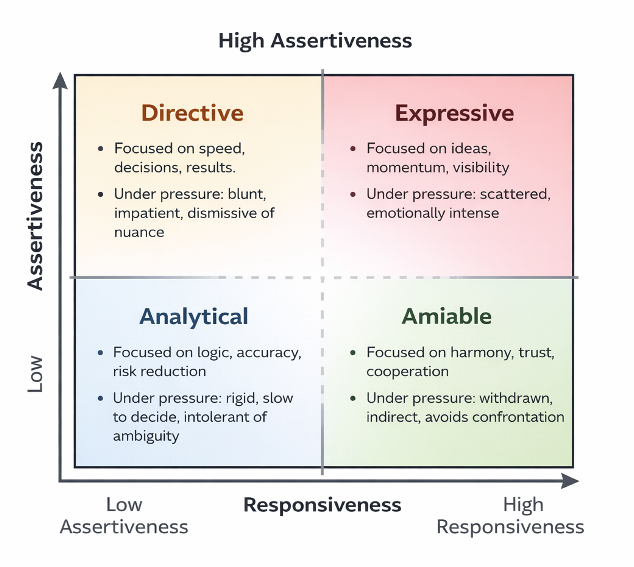
In Agile environments, delivery failure rarely stems from incompetence or lack of process. It emerges when communication patterns clash under pressure.
The Agile Communication Profiling Framework (ACPF), developed through enterprise practice and formal training in communication management, treats communication as delivery infrastructure. Instead of asking teams to “communicate better,” it provides a structured way to:
- Identify dominant communication patterns within a team
- Anticipate where friction will surface during sprint planning, refinement, or retrospectives
- Adjust facilitation techniques to prevent escalation
- Surface hidden disagreement before it becomes rework
Practically, teams use the model to map interaction dynamics in ceremonies, recognize stress-driven behavioral shifts, and design meeting structures that balance speed, risk awareness, and psychological safety.
The objective is not to label individuals. It is to reduce delivery risk by making communication patterns visible and manageable.
This structure builds directly on social style theory developed by Merrill and Reid, which has been widely applied in leadership and organizational settings.
When Communication Styles Collide in a Sprint Review
One of the clearest examples happened to me during a sprint review on a large enterprise program I was supporting.
The engineering team reported that 95% of the committed scope had been delivered. From their perspective, this was a strong, transparent result. The remaining 5% consisted of minor refinements and low-impact bug fixes. Technically, nothing critical was missing.
However, the executive stakeholder reacted immediately to the number.
If the commitment was 100%, why was it not 100%? What exactly was not delivered? Was something being downplayed?
The developers were confused. They believed they were being precise and honest. The stakeholder believed something was incomplete. The tension was not about delivery. It was about interpretation.
What I recognized in that moment was a communication style mismatch. The team was communicating analytically through percentages, variance, and detail. The stakeholder was communicating directionally through commitment, outcome, and risk visibility.
Instead of letting the discussion escalate, I reframed the conversation. I asked the team to clarify the business impact of the missing 5%. Was any customer-facing functionality affected? Was the release at risk? Was any contractual commitment unmet?
When they answered no, I translated their message:
“All committed business-critical functionality is delivered. The remaining items are minor refinements that do not affect release readiness.”
The stakeholder relaxed immediately. The team understood that the issue was not performance, but framing. Nothing about the work changed. Only the language changed.
What This Demonstrates
That situation reinforced something I see repeatedly in Agile environments: delivery friction often emerges not from capability gaps, but from style misalignment under pressure.
Using the Agile Communication Profiling Framework in practice means recognizing those mismatches in real time and adjusting the translation layer between stakeholders.
It is not about labeling people. It is about making sure analytical precision does not accidentally trigger executive alarm.
After that session, the team began proactively framing delivery updates in business-impact language when addressing highly assertive stakeholders. Escalations during reviews dropped, and discussions shifted from defensiveness to alignment.
These patterns are consistent with research on interpersonal conflict and communication mismatch.
In the classroom, students quickly recognize these dynamics from their internships, part-time jobs, or project teams. What surprises them is how predictable the collisions are once you name the profiles.
Teaching Perspective-Taking as a Technical Skill
One of the core exercises in the workshop requires students to retell a conflict entirely from the other party’s perspective.
This exercise is grounded in research on perspective-taking, which shows that actively adopting another viewpoint reduces escalation and increases cooperation.
In software teams, perspective-taking is often dismissed as “soft.” In reality, it directly affects requirements negotiation, architectural compromise, and stakeholder alignment.
When students realize that perspective-taking improves delivery outcomes, not just relationships, resistance drops quickly.
From Accusation to “I-Statements”
Another practical component of the course focuses on rewriting accusatory language into I-statements.
This technique originates in client-centered psychology and was later formalized in conflict communication models.
For example:
“You never prepare for meetings” becomes “I struggle to move us forward when meetings start without preparation.”
This shift reduces defensiveness while keeping responsibility explicit. In Agile teams, that difference often determines whether feedback leads to learning or shutdown.
Power Without Titles
A critical part of ACPF I use addresses power dynamics.
Power in Agile systems does not come only from hierarchy.
In IT teams, developers often hold significant expert power. Silence, jargon, or selective framing can influence decisions as effectively as authority.
ACPF teaches students to recognize these dynamics early, not to accuse, but to redesign communication before manipulation or resentment takes hold.
Why This Belongs in Technical Education
Engineering and computer science education traditionally focuses on correctness, efficiency, and optimization. Real delivery environments demand something more: adaptive communication under pressure.
Edmondson’s research on psychological safety shows that teams learn and adapt faster when people can speak without fear of punishment or humiliation.
Communication profiling gives future IT professionals a concrete way to build that safety without relying on personality or goodwill.
From University Classroom to Industry Practice
The Agile Communication Profiling Framework is not an academic abstraction. It is designed to transfer directly into professional environments.
Its originality does not lie in inventing new psychology. It lies in operationalizing established theory for Agile delivery, where communication failure is one of the most common and least visible causes of breakdown.
Teaching it at a technical university makes that explicit: communication is not decoration. It is part of the system.
Additional references:
- Cramer, P. (2006). Protecting the Self: Defense Mechanisms in Action. Guilford Press.
- De Dreu, C. K. W., & Weingart, L. R. (2003). Task versus relationship conflict, team performance, and team member satisfaction. Journal of Applied Psychology, 88(4), 741–749.
- Edmondson, A. (1999). Psychological safety and learning behavior in work teams. Administrative Science Quarterly, 44(2), 350–383.
- French, J. R. P., & Raven, B. (1959). The bases of social power. In Studies in Social Power.
- Galinsky, A. D., et al. (2008). Perspective-taking and self–other overlap. Journal of Personality and Social Psychology, 95(2), 378–389.
- Gordon, T. (1970). Parent Effectiveness Training. Wyden Books.
- McAvoy, J., & Butler, T. (2009). The role of communication in agile systems development. European Journal of Information Systems, 18(3), 206–219.
- Merrill, D. W., & Reid, R. H. (1981). Personal Styles and Effective Performance. Chilton.
- Rogers, C. R. (1961). On Becoming a Person. Houghton Mifflin.
- Vaillant, G. E. (1977). Adaptation to Life. Harvard University Press.





Lets Hang!