With organizations growing at a rapid pace—particularly in the IT industry—there is a continuous need for new teams to be formed, aligned, and made productive quickly. With Agile already being widely adopted and AI now acting as an accelerator, the expectation for teams to self-organize and start delivering value has increased significantly.
However, the reality for most newly formed teams is quite different. Team members often do not know each other well, trust levels are low, and communication is hesitant. Collaboration does not come naturally, and expecting immediate self-organization or self-management becomes impractical. This results in low morale, weak alignment, delayed decision-making, and reduced team effectiveness.
Newly formed Agile teams frequently struggle with unclear roles, limited trust, and insufficient understanding of how to work together effectively. These issues are particularly prominent in the early stages of team formation, where shared norms and working agreements have not yet been established. As a result, teams fail to function cohesively and cannot fully realize the benefits of Agile methodologies.
If we reflect on the Agile Manifesto, it becomes clear that Agile is fundamentally centered around people. Two of its core values—individuals and interactions over processes and tools and customer collaboration over contract negotiation—highlight the importance of human interaction. Additionally, several principles emphasize trust, collaboration, and communication, such as building projects around motivated individuals, encouraging daily collaboration between business and development teams, and recognizing face-to-face communication as the most effective way to share information.
It is therefore not an exaggeration to say that one of the biggest contributors to the success or failure of an Agile initiative is people—how they interact, collaborate, and build trust.
This is where team-based experiential learning becomes powerful. Introducing structured, engaging activities can help teams break initial barriers and accelerate their journey toward collaboration and self-organization. One such activity, both simple and highly effective, is the Mafia game.
The Crucial Gap: What AI Overlooks in Project Management
The rapid adoption of AI in Agile and project management has improved planning, estimation, risk identification, reporting, and decision support, helping teams make faster, data-driven decisions.
However, many challenges faced by newly formed Agile teams are not process problems—they are human ones. Trust, psychological safety, empathy, and the confidence to challenge ideas or admit mistakes emerge through interaction and shared experiences. While AI can analyze patterns, provide insights, and recommend actions, it cannot create the trust, mutual understanding, and collective ownership required for true self-organization.
These qualities develop through people interacting, collaborating, and learning from one another. Experiential activities such as the Mafia game help teams build these human foundations in ways technology alone cannot.
The Mafia Game as an Experiential Learning Tool
Mafia is a social deduction game where players must identify hidden roles within a group through discussion, observation, and collective decision-making. While it may appear to be just a recreational activity, it closely mirrors many dynamics present in Agile teams—uncertainty, incomplete information, collaboration under pressure, and the need for trust.
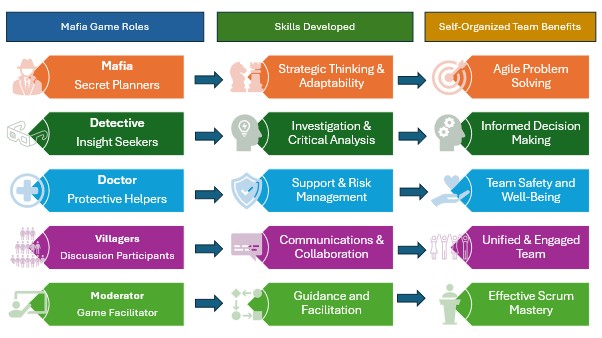
Figure 1: Mafia Game Roles and How They Help Teams Become Self – Organized
Objective of the Game
Players are divided into two main groups:
- Mafia – aim to eliminate villagers without being detected
- Villagers – attempt to identify and eliminate Mafia members through discussion and voting
The objective of the game is straightforward but relies heavily on collective decision-making.
Roles and Responsibilities
Each participant is assigned a role at the beginning of the game:
- Villagers
- Do not have any special powers
- Rely entirely on communication and observation
- Mafia
- Know each other’s identities
- Secretly eliminate one player during each round
- Detective
- Investigates one player at a time
- Determines whether the player belongs to the Mafia
- Doctor
- Can save one player from elimination
- Moderator
- Facilitates the game and manages overall flow
Recommended Team Composition
Below is the recommended team size. However, it can be adjusted based on the number of participants:
Total Team Size | Mafia | Villagers | Detective | Doctor / God |
|---|
6 (Small Team) | 2 | 3 | 0 | 1 |
9 (Desired) | 3 | 4 | 1 | 1 |
12 | 4 | 6 | 1 | 1 |
15 | 5 | 8 | 1 | 1 |
20 (Large Team) | 8 | 10 | 1 | 1 |
Game Flow (Repeated Cycles)
The game progresses in cycles consisting of four phases:
1. Night Phase
- All players close their eyes
- Mafia selects a target
- Doctor attempts to save someone
- Detective investigates a player
2. Morning Phase
- Moderator reveals the outcome of the night
- Indicates whether a player was eliminated or saved
3. Discussion Phase
- Active players openly debate
- Analyze behaviors and interactions
- Attempt to identify the Mafia
4. Voting Phase
- Players collectively decide whom to eliminate
This cycle continues until:
- All Mafia members are eliminated, or
- Mafia outnumber the villagers
Adaptability (Physical and Remote Teams)
- Physical Setup
- Roles assigned using cards or chits
- Remote Setup
- Conducted via video conferencing platforms
- Private messages enable role communication
The simplicity and flexibility make it highly accessible for teams of varying sizes and configurations.
Behavioral Outcomes Relevant to Agile Teams
What makes Mafia particularly effective is not just the structure of the game, but the behaviors it encourages:
- Speaking, listening, and observation
- Persuasion and influencing
- Collaboration and collective decision-making
- Dealing with ambiguity and incomplete information
- Forming hypotheses and validating assumptions
- Building trust, empathy, and psychological safety through direct human interaction—capabilities that AI can support but cannot fully create or experience on behalf of team members.
These are essential skills in Agile environments and are naturally practiced during the game.
Mapping Agile Team Challenges to Mafia Game Outcomes
The following table maps common challenges faced by Agile teams to how the Mafia game helps address them.
Challenge | Description | How the Mafia Game Addresses It |
|---|
Poor Communication and Collaboration | Gaps in communication, hesitation in interaction, and limited collaboration across team members. | The discussion phase encourages players to express ideas, question others, and defend viewpoints. Over multiple rounds, participants become more comfortable communicating, improving day-to-day interactions. |
Workload Balancing and Shared Ownership | Imbalance in participation, responsibility, or task allocation leading to uneven contributions across the team. | The game encourages active participation from all players and reinforces the importance of collective responsibility, helping teams develop a stronger sense of shared ownership and balanced contribution. |
Lack of Team Cohesion | Absence of bonding and trust, especially in newly formed or distributed teams. | Shared experiences, informal interaction, and engagement during the game help build trust and emotional connection among team members. |
Role Confusion | Unclear responsibilities resulting in overlaps, gaps, and inefficiencies. | Clearly defined roles in the game reinforce the importance of role clarity and accountability within a team setting. |
Daily Stand-ups Becoming Status Meetings | Shift from collaborative planning to mere reporting of updates. | The interactive discussion phase promotes meaningful dialogue, encouraging teams to move beyond status updates toward collaborative conversations. |
Ineffective Sprint Retrospectives | Lack of meaningful reflection and actionable improvements. | Repeated game cycles encourage reflection, observation, and behavioral adjustments—similar to effective retrospectives. |
Difficulty in Becoming Self-Organizing | Dependence on direction rather than proactive ownership and decision-making. | Players make independent decisions without instructions, promoting ownership, initiative, and collective decision-making. |
Case Study: Enabling Self-Organization in a Large Agile Setup
A large offshore center had to be set up quickly with a team of 100+ people to take over knowledge from a US team that was exiting. Around 90% of the team was hired within two months, with members coming from different external organizations. There was significant hesitation in communication and collaboration among team members.
As a result, the team struggled to talk to each other and collaborate effectively. This led to low performance, with reduced velocity and poor sprint goal compliance.
After trying multiple employee engagement techniques with limited success, the Mafia game was introduced as an innovative approach. Sessions were conducted across teams in batches over a two-week period, with team mixes designed to increase interaction.
The team responded positively and gradually started opening up. The overall environment became more communicative and collaborative. Teams demonstrated greater self-organization and ownership, accompanied by improvements in velocity and sprint goal compliance.
Conclusion
Agile transformations often focus heavily on frameworks, tools, and metrics. While these elements are important, they are not sufficient on their own. While AI can accelerate planning, reporting, and decision support, the true foundation of Agile lies in people—their ability to communicate, collaborate, and build trust.
The Mafia game illustrates how a simple, well-designed activity can create meaningful behavioral change within teams. By providing a safe and engaging environment for interaction, it helps teams overcome initial barriers and accelerates their journey toward becoming high-performing, self-organizing units.
In many cases, the most effective solutions are not complex or expensive. They are simple, human-centered, and experiential. The key is to create opportunities for teams to interact, learn, and grow together.
Before introducing another process improvement or tool, it may be worth asking a different question: can a simple game achieve what structured interventions often struggle to deliver?






Lets Hang!