When I look back at my years working as a QA Engineer, QA Lead, and QA Manager, I realize one common frustration: most testing frameworks solved only part of the problem. They worked for certain projects or contexts but left big gaps in others. They focused narrowly on test cases, automation, or compliance, while overlooking global quality needs, the cadence of releases, or the unique demands of specific industry verticals.
That frustration became fuel. After countless sprints, retrospectives, and delivery cycles, I created my own approach: the 3x3 QA Management Framework. This is an adaptable and flexible framework for Quality Management; it’s not rigid or static. It flows, it adapts, and when executed well, it creates harmony across agile delivery.
This framework was not born overnight. It emerged from years of observing what worked, what broke, and what consistently left teams stressed or customers disappointed. Today, I want to share how this approach works, why it’s different, and how you can apply it in your agile environments.
Why Another Framework?
Every QA manager has faced the same dilemmas:
- How do we balance speed with quality in a world of constant releases?
- How do we satisfy both business stakeholders and end users?
- How do we align test practices across projects while respecting the cadence of agile iterations?
Existing frameworks tend to prioritize one dimension at the expense of others. Some are excellent at automation but ignore strategic risk mitigation. Others emphasize compliance and process rigour but slow down release cadence. I found myself patching holes constantly, borrowing a little from one model and improvising on another.
The result was inconsistency, and worse, inefficiency. Teams were working hard, but not always working smart.
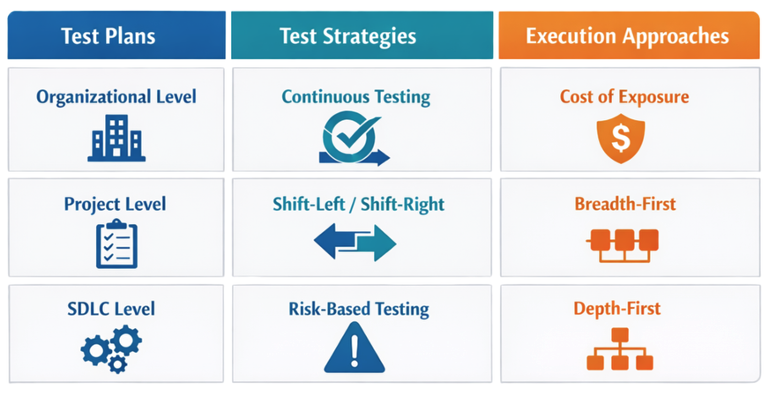
The 3x3 QA Management Framework emerged as an answer to this. It ensures that testing activities are:
- Aligned at three levels (organizational, project, and SDLC).
- Driven by three strategies (Continuous Testing, Shift-Left, and Risk-Based Testing).
- Executed through three approaches (Depth-First, Breadth-First, and Cost of Exposure).
The Three Test Plans
The foundation of the framework is simple: quality must be planned at three levels, each feeding into the next.
- Organizational Test Plan
This is the overarching guide. It sets the tone for quality across the company standards, methodologies, tools, and compliance with industry benchmarks. Think of it as the blueprint that ensures every project is pursuing the same goal.
- Project-Level Test Plan
Here is where flexibility comes in. Each project has its own scope, risks, timelines, and technologies. The project-level plan tailors the organizational standards to the project’s reality while considering the Organizational Test Plan as a guide.
- SDLC-Level Test Plan
Agile, DevOps, or hybrid, whatever lifecycle you are working in, testing must be fully integrated into it. This plan ensures testing fits naturally into the development cadence. This plan specifies testing activities tied to each phase of the SDLC, including continuous integration, automation strategies, acceptance criteria, and monitoring practices. This helps ensure that testing is ongoing and adaptive to changes during the development process.
Together, these three levels create consistency, adaptability, and alignment with business goals. By creating these three levels of test plans, a QA manager ensures that testing activities are consistent with organizational goals, flexible to individual project requirements, and adaptive to specific development practices (like DevOps), leading to a robust and efficient quality assurance process.
Keep in mind that the test plan that varies significantly is the Project Level Test Plan; both Organizational and SDLC Level Test Plans are expected to suffer little to no variations from project to project.
The Three Testing Strategies
Now comes the part that requires all your QA knowledge to be put in practice. Too often, teams try to apply strategies in isolation. In my experience, the real magic happens when they are combined.
- Continuous Testing
This is the heartbeat of agile QA. Unit tests and regression tests are run automatically within CI/CD pipelines, providing rapid feedback. The goal is stability: no wasted manual effort on obvious breakages, faster iterations, and robust builds.
- Shift-Left Testing
Quality must start early. Engaging QA during requirements, design, and coding phases prevents costly defects downstream. This includes test-first practices like TDD and BDD, plus early performance and security testing. This requires hosting necessary meetings, involving QA in every process step, and formally establishing these practices across the organization. Quality is a shared responsibility; it is not isolated to the QA team only.
- Risk-Based Testing
No project has infinite time or resources. Risk-based testing helps prioritize by focusing effort where failure would hurt the most. Risk-based testing involves the identification, assessment, monitoring and mitigation of risks to prioritize tests. The higher the risk level, the earlier the testing should begin and the more intense and prolonged the test effort should be. By focusing on areas that present the highest risk, you can ensure critical functionalities are thoroughly tested, which is essential in a DevOps environment where rapid delivery is the baseline. This strategy includes: Risk Analysis & Risk Control.
Let’s review our Risk-Based Strategy, as it will give life to the execution approach we choose later. Our risk-based strategy is composed of two phases:
Phase 1 - Risk Analysis: This phase is divided into the following actions: Risk Identification and Risk Assessment
- Risk Identification utilizes expert reviews, retrospectives, and workshops to surface potential threats. At this stage, It is essential that the list of participating stakeholders is accurate and agreed upon with the Project Manager.
- Risk Assessment: After identifying the project risk it is time to determine the Risk Level (Very High, High, Medium, Low) by establishing the risk likelihood of occurrence, and the risk impact upon occurrence. Quality Risk assessment includes the categorization of risk by type: Product Risk or Project Risk.
Phase 2 - Risk Control: This phase is divided into the following two actions: Risk Monitoring and Risk Mitigation
- Risk Monitoring Strategy: Involves collecting and recording test results, identifying deviations and monitoring the occurrence of identified risks.
- Risk Mitigation Strategy: To mitigate the identified risks, we will use the prioritization of the test execution based on the Risk level assigned to the test scripts associated with each feature/functionality.
Remember: In software development, testing is the most important quality risk mitigation activity, and makes it possible to reduce the likelihood of failure.
These three strategies are not rivals. They are partners in a strong and robust Test Management Framework. Continuous testing provides stability and a strong base, shift-left ensures early testing and cheap fixes, and risk-based keeps actions aligned with what really matters.
The Three Execution Approaches
This is where the framework shows its pragmatic side. Execution is not just about what we test, but in what order. With the same time, the same resources, and the same scripts, results can be optimized simply by selecting the right sequence.
Depth-First Execution
Start with the highest-risk areas and test them thoroughly. This ensures critical functionality is secured early.
Used when it is a priority to mitigate the highest level risks as early as possible
Breadth-First Execution
Run at least one test for every identified risk, regardless of level. This provides an early global view of product quality, which is especially valuable when stakeholders demand quick feedback.
Appropriate when stakeholders want an overall view of the product quality as early as possible
- Cost of Exposure Execution
Here, decisions are based on economics. If the cost of a defect in production is ten times higher than early detection, testing that area becomes mandatory.
Useful to decide where we want to put extra effort or allocate Senior resources
These approaches are not mutually exclusive. They can be mixed, combined, you can start with one and after the first cycle change the approach, depending on project priorities and risk appetite.
Why This Framework Works
The 3x3 QA Management Framework addresses three persistent pain points in agile testing:
- Global quality, not partial fixes. It considers organizational standards, project realities, and lifecycle integration.
- Cadence of releases. It aligns testing with agile iteration speed without sacrificing robustness.
- Industry and vertical needs. Whether you’re in fintech, healthcare, or e-commerce, the framework adapts, because risk, compliance, and cadence vary by domain.
It’s not about reinventing every wheel, it’s about orchestrating them so they move in harmony.
A Closer Look at Execution
Many managers believe that increasing test coverage or adding more testers is the path to quality. In reality, I’ve seen teams achieve much stronger results without changing resources at all.
The secret is in execution order. By reordering the same test scripts, you can:
- Detect critical issues earlier.
- Provide stakeholders with actionable insights sooner.
- Reduce wasted effort on low-priority areas.
For example, one project applied breadth-first execution first to give stakeholders a snapshot, then switched to depth-first to harden the riskiest modules. The outcome was fewer late surprises and a smoother release cadence. Same people, same time, same scripts, completely different impact.
Lessons Learned Along the Way
Implementing this framework across teams taught me some important lessons:
- Balance matters. Continuous testing keeps the rhythm, shift-left prevents backlog of defects, and risk-based ensures smart prioritization. Drop one, and the dance stumbles.
- Culture is as important as tools. A framework only works if people believe in it. Training, communication, and stakeholder engagement are essential.
- Don’t aim for perfection. The goal is progress, not flawless execution. Retrospectives and adaptations keep the framework alive.
Technology keeps evolving, and QA and Testing methodologies are ready to face what comes next. The 3x3 framework is the map that ensures we don't just test more, but test better.






Lets Hang!