Customization of an application involves changing the application to suit your customers’ needs and wants, or the requirements of the end users. Customization can be requested by corporate players or government players. It involves in-depth research into factors such as usability, aesthetics, functional usage, best practices, and logistical requirements. While many factors contribute to successful customization, this article explores ways to customize Customer Relationship Management (CRM) web pages for AI integration and how to apply these AI capabilities to software testing.
Defining AI Integration in the CRM Space
True AI integration within a CRM involves more than a simple replacement of legacy systems; it is an augmentation of the existing architecture. By embedding machine learning and automation directly into current workflows, organizations can create a hybrid environment where human intuition is scaled by high-speed data processing and predictive analytics.
Some people would ask what the benefit of AI is to software testing. In the QA sector, AI is shifting the paradigm from manual verification to predictive analysis. By automating repetitive execution and analyzing historical data to predict defect clusters, AI-driven tools allow testers to move away from rote tasks and focus on high-value activities like exploratory testing and strategic risk assessment.
Practical Customization: Voice-Enabled Search
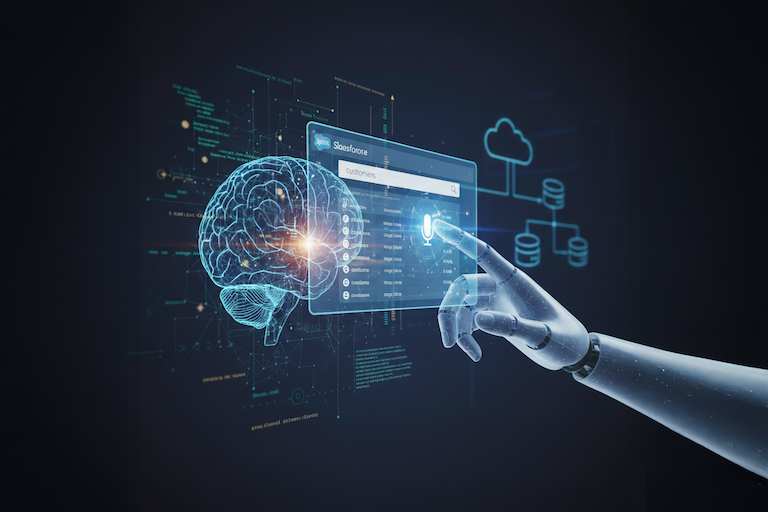
For customization of CRM tools, we begin with the search bar where a user can look up user accounts. In this area, it is possible to have voice input similar to Siri or Alexa where one speaks the customer or vendor they want to display and presses Enter, displaying a list of the relevant customers and vendors. Voice input reduces manual data entry and minimizes the time required to navigate large datasets.
The placement of the voice icon would be a microphone or something similar indicating that it takes that kind of input. The modification is similar to the microphone icon used for text dictation and on search bars.
Voice input can be integrated across various list-based web pages to streamline data filtering. For instance, in Salesforce, adding voice capabilities to a standard list view allows users to filter large member datasets hands-free, significantly improving navigation efficiency.
Streamlining Workflows and Test Data Generation
Another area where AI can be used is to automate the creation of workflows to speed up testing. When you create a knowledge article in Salesforce, for example, you have to assign it a Request Call Flow so it knows which menu option the article should fall under. The whole process can be automated where one of the few variables that needs to be assigned upon execution of the code is the Request Call Flow. Automation removes the necessity of repeating these identical procedural steps for every new entry. And a different name would have to be given for the knowledge article created.
It is possible to automate the assignment of roles and groups in CRM tools for a standard kind of user. This would speed up the creation of test data. For example, if the role was for agents, you would state that each agent has the permission to create accounts and automate that. However, one has to be careful that the permissions for one role do not conflict with the permissions for other roles that are assigned. Sometimes that does happen.
The Unified Source of Truth: Centralized Databases
The beauty of many of these CRM tools is that they have centralized databases for customer relationship management. One can look at Salesforce, Microsoft Dynamics 365, HubSpot, Pipedrive and others. Centralized CRM databases act as a unified source of truth, effectively eliminating data silos that often hinder QA cycles. This architectural cohesion ensures data integrity and provides testers with real-time access to the datasets needed for complex integration testing and end-to-end validation.
Assuming that they are all somewhat similar, a tester can access user accounts from a central database, make modifications to the user accounts from that database, delete user accounts if necessary, and manage the customers.
While the concept of digitizing customer data started in the 1970s, the integration with AI is relatively new.
Only in the last 15 years has this AI integration evolved. AI provides a useful tool for integration into existing software. Even with the canned features, a development team can customize the CRM tools to include AI functionality. AI is a great development in software but one has to be careful about hallucinations—a phenomenon where AI generates factually incorrect but confident-sounding data. There might need to be some error checking before reporting on QA tasks to upper management. In my experience, upper management really enjoys the reporting done by QA professionals.
Looking Ahead: The Cost and Future of AI-Driven QA
With regard to software testing and AI, these optimizations will speed up the amount of time it takes to manually test the software and create test cases. Also, the automation capabilities increase exponentially by using AI. So, it is better to incorporate it into the CRM tools if you do not want to buy software packages that have AI built into them. The cost of customizing the CRM tool for AI integration might be cheaper than buying the AI-centric tool. Although, due to time constraints, it was not possible to conduct this study. The topic could be a direction for further research.
While testers are under pressure to incorporate AI into their test case research and test case creation, the tools they use to test should also include AI. However, I disagree that every tool needs to have AI in it. It would be an interesting research topic to assess how much AI has changed the QA profession.
Also advancing the profession is coursework in AI and software testing. Those of us that are already in the field look forward to this advancement in software testing and in software development. The horizon of software development has brightened significantly with these advancements.





Lets Hang!