Danny R. Faught

Member for
25 years 4 months
All Articles by Danny R. Faught
All Stories by Danny R. Faught
| Deconstructing Our Tools | |
| Testers from Another Planet Software professionals are prone to classic nerdy behavior, but a few may actually be suffering from something deeper that interferes with both their work and their personal life. It may feel like they are from an alien culture and speak a different language, even though they're using the same words as everyone else. In this column, Danny R. Faught describes how this problem has affected him and how you can better integrate into the alien culture if you or someone you know is affected. |
|
| Unit vs. System Testing-It's OK to be DifferentThere are two distinct roles in many software projects that are involved with testing: developers and testers. Should they take the same approach to testing, or are there some principles that apply to only one of the roles? What should they do to coordinate their work? Danny Faught went through an exercise to compare and contrast and found that the questions he couldn't answer were as interesting as the questions he could answers. | |
| Real-World MathMath is often not easy to learn, even for those of us who enjoy it. And if you don't use your mathematical knowledge, you just might forget how to use it. Danny Faught likes math and has found ways of using basic math like algebra, the modulo function, expected values, and logarithms in testing. It's kept his mind fresh on mathematical concepts and formulas, and he hopes it will do the same for you. In this week's column, he explains how to use math to improve testing. | |
|
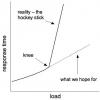
Peeling the Performance Onion Performance tuning is often a frustrating process, especially when you remove one bottleneck after another with little performance improvement. Danny Faught and Rex Black describe the reasons why this happens and how to avoid getting into that situation. They also discuss why you can't work on performance without also dealing with reliability and robustness. |

|
Bisection and Beyond When you search through an ordered list, like a dictionary or phone book, you're probably using the bisection technique to find the information you need rather than starting at the beginning of the book and turning the pages one at a time. In the world of testing, bisection can make your testing much more efficient. In this week's column, Danny Faught describes the basic bisection technique and how to modify it in order to better respond to the real world. |
| Synthesize Your Test Data | |
| Toolsmiths-Embrace Your Roots People have been automating software development, testing, and deployment processes since the stone age of software. The toolsmith of today shares a lot in common with these ancestral automation efforts. In this week's column, Danny Faught details how toolsmiths can learn by studying the computer subcultures of the past and present that are similar to their own. |
|
| Challenges of the Part-Time Programmer | |
| Hurdling Roadblocks We all encounter things at work that impede our progress. Having the skill to effectively deal with the roadblocks makes a big difference in your overall productivity. Will you get a reputation as a whiner or as someone who pushes through obstacles? In this week's column, Danny Faught offers help with two common types of roadblocks and gives suggestions for reducing the chances that any barricade will impact your schedule. |
|
| Get to the Point | |
| Wreaking Havoc With Simple TestsD | |
| Exploratory Load Testing | |
| A Bug Begets a Bug | |
| Five Minutes Ahead of the Boot | |
| After the Bug Report | |
| Keyword-Driven TestingA | |

|
Being Resourceful When Your Hands Are Tied You work hard to find tools that can help you. You learn how to use and configure them. Then you find yourself working in an environment where you can't even use them. Have you encountered this frustrating situation? Danny and Alan have encountered this frustration many times before, and in this week's column, they're here to say you don't have to abandon all hope. If you're creative, you can still find tools to use–even in the most inhospitable environments. |

|
Meaningful Connections In this week's column, Danny R. Faught discusses some techniques on how to beef up your networking game. He compares successful to not-so-great tactics for meeting people who can help us. He also guides us in the ways of maintaining relationships. His bottom line: the focus should always be on creating meaningful connections. Networking shouldn't just be about meeting people, but about learning how to wisely judge their value as well. |
| A Testing Career in 3-DE | |
| Testing, Zen, and Positive ForcesT | |
| Dear Aunt Fern ... (This is What a Software Tester Does)A | |
| Testware for Free Want the 4-1-1 on freeware but don't know where to start? A virtual cornucopia of programs awaits your discovery. In this week's column, Danny Faught details some of the testware he has researched, and explains why it's important to have freeware in your testing tool bag of tricks. |
|
| The Making of an Open Source Stress Test Tool The objectives of the paper are to: 1) introduce you to an open source stress test tool, the stress_driver, which you can use and modify in your own environment; 2) explain the benefits and limitations of a general-purpose reusable stress test tool; and 3) describe some of the implementation details involved in building a heavy-duty test driver using a scripting language. |
|
| An Elusive Diagnosis: Diary of a Software Bug HuntThis article is a description of a bug hunt from one of Danny Faught's consulting engagements. He describes in detail all the dead ends, and how I eventually tracked down the problem, including some important lessons that I learned. | |
| Experience with OS Reliability Testing on the Exemplar System In this paper I will discuss the development and use of the Continuous Hours of Operation (CHO) test which was developed for the Convex Division of Hewlett-Packard. My goal is to help readers with the practical aspects of developing a load test which can be used to help gauge and improve the reliability of a software system. I will briefly mention how we were unable to make much use of currently available software reliability frameworks, partially because of their deficiencies, and partially because of our inadequate knowledge of them. I knew enough about the theories to know that we did not have enough data to calculate a Mean Time to Failure metric; however, we were still successful in improving the reliability of our product and using the results of the CHO test as a release criterion. |