AI can generate test cases from requirements in seconds. Run it on Monday, get 12 tests. Run it on Wednesday with the same requirements, and get 8. Run it Friday, get 15. Different coverage, different edge cases, different results. This isn’t a software defect. It’s the fundamental nature of generative AI and LLMs.. They're probabilistic, not deterministic, and that characteristic fundamentally breaks traditional testing workflows. This article examines why consistency and auto-validation matter more than speed in AI test generation. It provides a practical validation framework with simple metrics that teams can implement without expensive tools or complex infrastructure.
The Core Testing Workflow and Why AI Breaks It
The Test coverage workflow has followed three straightforward steps:
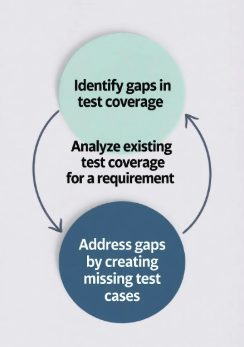
Manual execution of this workflow is slow, but it's predictable. The same tester analyzing the same requirement will identify similar gaps and create comparable tests. Deterministic process, repeatable results.
AI test generation appears to accelerate this workflow dramatically. Point an LLM at requirements documents, generate comprehensive test suites in minutes, and close coverage gaps before the next sprint. The value proposition is compelling: faster delivery, broader coverage, reduced manual effort. However, this acceleration comes with a critical limitation: LLMs produce different outputs for identical inputs. Run the same requirement through the same model twice, and you'll get different test counts, different coverage patterns, and different edge case detection. This inconsistency isn't a defect in the AI implementation; it's inherent to probabilistic systems.
This creates a critical problem: if the "address gaps" step produces inconsistent results, how do you measure coverage? How do you know which gaps are actually closed? How do you make release decisions based on test suites that might be different tomorrow?
For testing teams, this translates to real-world consequences: releases delayed for manual verification, coverage reports that don't reflect actual risk mitigation, and sprint planning that can't rely on test commitments. Product managers lose confidence in quality gates, and development teams waste cycles regenerating tests instead of building features. Speed becomes irrelevant when you can't trust the output, and unreliable test generation erodes the entire value proposition of AI-assisted testing.
Why Probabilistic Outputs Matter for Testing
Large language models work by predicting the most likely next token based on probability distributions. Same input, different sampling, different output. Temperature settings, token selection strategies, and even processing load can shift results.
For creative writing or brainstorming, this variability is a feature. For test generation to catch costly defects, it's a fundamental challenge. To understand the practical impact, consider a common scenario: A requirement states that the system must validate email format before account creation.
- Run 1: 6 tests covering format validation, null values, and maximum length
- Run 2: 9 tests adding Unicode characters, consecutive dots, and international domains
- Run 3: 5 tests, now missing the Unicode edge cases from Run 2
Which output is "correct"? The one with the most tests? The one with the best edge case coverage? There's no objective answer because the model is sampling from possibilities, not calculating deterministic solutions.
This variability compounds across the testing workflow, creating cascading problems that affect entire delivery teams:
- Coverage analysis becomes stale immediately. You analyze what tests exist, but regeneration might produce different coverage tomorrow. Project managers tracking coverage metrics find their dashboards unreliable, making it impossible to answer stakeholder questions about quality progress.
- Gap identification depends on which run you use. Gaps you identify today might be "covered" in tomorrow's generation or might reappear next week. QA leads cannot confidently report risk status, and the same requirements may trigger multiple rounds of test generation work.
- Sprint planning breaks down. How many tests will you generate? How much coverage will you actually achieve? The answer is "it depends." Teams cannot estimate effort or commit to coverage targets, undermining agile planning and velocity tracking.
- Release confidence suffers. Can you ship based on tests that might not exist if you regenerate them? Release managers face an impossible choice: delay releases to manually verify AI output, or proceed with confidence in tests they cannot reproduce. Neither option supports reliable delivery.
The industry has spent decades building deterministic test automation. CI/CD pipelines, coverage tools, and quality gates all assume that tests behave consistently. Probabilistic test generation challenges the entire foundation. Given this shift, teams need a new approach to measure and manage test quality when using AI generation. The solution isn't to make AI deterministic. That's impossible. The goal is to make its probabilistic nature measurable and manageable.
Making Reliability Measurable
Without measurement, teams are guessing. Quality requires measurement. "Good enough" test coverage isn't a strategy; it's hope. The same principle applies to AI-generated tests: teams cannot improve what they don't measure, and they cannot trust what they can't verify.
I recommend three core metrics to address the reliability challenge:
1. Traceability: Linking Tests to Intent
Every generated test must map to a specific requirement or risk. Orphaned tests indicate either redundant coverage or undocumented assumptions, and both are technical debt.
- Target: 95% of tests link to valid requirements
- Why it matters: Untraced tests can't be validated against changing requirements. When requirements change (and they always do), teams must manually audit untraced tests to determine if they're still relevant. This manual work negates the efficiency gains of AI generation. Lower traceability means higher maintenance overhead, more false-positive test failures, and reduced confidence that critical requirements are actually covered.
2. Consistency: Measuring Variance Across Runs
Measure the similarity of test sets across runs on the same requirement. High variance indicates unreliable gap analysis and unpredictable coverage.
- Target: Test coverage % should either remain the same or increase with regeneration
- Why it matters: Inconsistent generation means unreliable coverage measurement. Teams reporting high variance in test coverage cannot confidently answer basic questions: "Did we improve coverage this sprint?" or "Are we ready to release?" becomes guesswork rather than data-driven decision-making. High variance forces teams to regenerate tests multiple times and manually reconcile differences, eliminating the productivity gains AI promised to deliver.
3. Completeness: Validating Actual Behavior
Tests must catch defects, not just execute successfully. Mutation testing—injecting intentional bugs reveals whether tests validate the right behavior.
- Target: 70% mutation-kill rate
- Why it matters: Passing tests that don't catch bugs creates false confidence. Production incidents trace back to features that had "full test coverage" because the tests executed, but didn't validate actual business logic. Teams shipping with low completeness metrics discover defects in production that cost significantly more to fix than if they'd been caught earlier. False confidence from high coverage percentages with low completeness leads to release decisions that backfire, damaging stakeholder trust and team reputation.
These three metrics establish a baseline. Before implementing AI test generation at scale, run it multiple times on a sample of requirements and measure:
- How many tests link to requirements (traceability)
- How much test set similarity varies across runs (consistency)
- How many tests catch intentional bugs (completeness)
Without baseline numbers, there's no way to track improvement or identify problems. Metrics alone aren't sufficient. Teams need a systematic framework to validate AI-generated tests and integrate them into existing quality processes. This framework transforms metrics from retrospective analysis into actionable workflow gates.
The Validation Framework: Building Trust Through Process
Reliability doesn't come from better models or clever prompts. It comes from systematic validation built into the workflow.

1. Constrain: Input Quality Determines Output Quality
Only generate tests from requirements that include:
- Clear acceptance criteria
- Risk level classification (high/medium/low)
- Sample data or boundary values
Vague requirements produce vague tests. Constraining input improves output consistency and forces better requirement discipline upstream. Teams typically see test volume drop 20-30% with this constraint, but defect detection improves because coverage focuses on well-defined behaviors. This approach creates positive pressure on product and engineering teams to write clearer acceptance criteria, which benefits the entire development process beyond just test generation.
2. Generate: Treat Output as Draft, Not Deliverable
Once inputs are constrained, generation becomes more predictable but still requires a validation structure. AI-generated tests should include metadata:
- Requirement ID for traceability
- Risk level inherited from the requirement
- Confidence score (if available from the model)
- Explicit assumptions ("This test assumes...")
This metadata enables filtering and prioritization. Reviewers can focus on low-confidence tests for high-risk requirements instead of reviewing everything equally. However, metadata alone doesn't guarantee quality. Teams need systematic scoring to determine which generated tests are ready for production use and which require human intervention.
3. Score: Automate Quality Assessment
Implement automated scoring on each generated test:
Confidence Coverage Index (CCI): Score each test 1-3 on three factors:
- Clarity: Can someone understand what's being validated without deep context?
- Logical Soundness: Does the test logic match the requirement behavior?
- Maintainability: Is it obvious what changes when requirements update?
Average the three scores. Anything below 2.5 requires human review before promotion.
Mutation Testing: Inject intentional bugs into the code under test. Tests that don't catch these injected defects are validating the wrong behavior. This can be done manually by temporarily introducing defects or using mutation testing frameworks if your team has access to them.
Consistency Checking: Compare the current generation against previous runs to test for similarity. Flag significant changes to coverage patterns. Scoring provides assessment, but teams need automated gates that prevent unreliable tests from entering the test suite. Promotion decisions should be evidence-based, not ad hoc.
4. Gate: Promote Based on Evidence
Tests meeting scoring thresholds auto-promote to the test suite. Everything else routes to human review. This creates an accountability mechanism: teams see which tests require manual intervention and can identify patterns in AI failures.
When requirements change, automatically flag all linked tests as "suspect" until someone regenerates or manually validates them. This prevents stale tests from counting toward coverage metrics and forces continuous validation.
Gating promotes individual tests, but long-term reliability requires understanding patterns over time. Teams need observation mechanisms that track trends, not just point-in-time snapshots.
5. Observe: Track Trends, Not Just Snapshots
Log every generation event with prompt version, model identifier, and decision outcomes. This enables trend analysis:
- Is consistency improving or degrading over time?
- Which requirement patterns produce high-quality tests?
- Do certain model versions perform better for specific test types?
Treat this like any other production system: monitor, measure, and roll back when performance degrades. This framework looks complex, but teams can implement it incrementally without sophisticated tooling. The key is starting with manual processes and simple gates, then automating based on proven value.
Practical Implementation: Start Small, Scale Deliberately
Teams don't need complex processes or infrastructure to implement this framework. Start with manual tracking and simple gates:
- Week 1: Run AI test generation three times on five representative requirements. Define rules for when to regenerate tests after requirement changes. Measure test set similarity. If it exceeds the target, consistency is the primary problem.
- Week 2: Implement traceability gates. Reject any test without a valid requirement association. Track rejection rate to understand how much "creative" test generation is happening.
- Week 3: Manually score 20 generated tests on clarity, logical soundness, and maintainability (1-3 scale). Calculate the average CCI. Anything below the defined target (e.g., 2.0) indicates the model is generating noise.
- Week 4: Run mutation testing on critical tests. Inject bugs that should be caught. Calculate the kill rate. Low rates indicate validation problems, not coverage problems.
These four weeks establish baseline metrics and reveal whether AI test generation is ready for production use. Most teams discover that reliability improvements require workflow adjustments, not just better prompts or different models.
This brings us back to the fundamental industry challenge: speed without reliability creates more problems than it solves.
The Industry Challenge: Fast Isn't the Same as Reliable
The testing industry has a speed problem that AI promises to solve. But speed without reliability is just fast failure.
AI test generation is valuable when teams build validation around it. The technology can identify edge cases humans miss, generate comprehensive test matrices quickly, and maintain coverage as requirements evolve.
But only if teams measure reliability the same way they measure velocity. Only if consistency is tracked alongside test coverage. Only if completeness matters more than coverage percentages.
The shift from deterministic to probabilistic testing changes fundamental assumptions about quality assurance. Tests aren't artifacts anymore; they're samples from a probability distribution. Coverage isn't fixed; it's a range of possibilities. Release confidence, can't rely on yesterday's test run because tomorrow's might be different.
This isn't a reason to avoid AI test generation. It's a reason to implement it thoughtfully, with validation frameworks that acknowledge its probabilistic nature instead of pretending it's just faster test automation.
Measure traceability, consistency, and completeness. Gate promotion on evidence. Track trends over time. Treat AI outputs like draft code that requires review.
Start small. Validate everything. Scale when the metrics prove reliability.





Lets Hang!