Automated testing involves higher upfront costs and should be looked at as a long-term investment where the pay-offs come anywhere between 1-3 years down the road. One has to keep in mind that there are various intangible benefits associated with automation. Performing a return on investment (ROI) for your planned automation can however help you understand right at the beginning the actual returns that you will get from your investments and you can weigh those against the benefits you will gain from automation. An ROI analysis will not only help you determine the various elements associated in calculating the ROI and the approximate cost and benefit involved but it can also help you decide on the types of automation you want, the areas that you can potentially automate, the tools and the skill levels of the testing resources that will be required.
Calculating ROI
Quite often, automation is considered a transition from manual testing. However, the key is to look at the investment from a long-term perspective and see how it pays off.
The key parameters to be considered while initializing the ROI exercise are:
- Understand the focus of automation with respect to reducing testing cycle time, maximizing test coverage, reaching the market faster, cost benefits, etc.
- Estimate the existing test suite with respect to effort and cost
- Assess test automation tools
- Automate the entire system vs taking a step by step approach
- Understand the product and its technology road map
- Test Automation Framework design
While these parameters can aid in doing an initial analysis and determining the high level ROI, the results obtained can be used to delve into the details of calculating the real ROI.
The practical steps that are involved in the transition process from manual to automation are shown in the block diagram below:
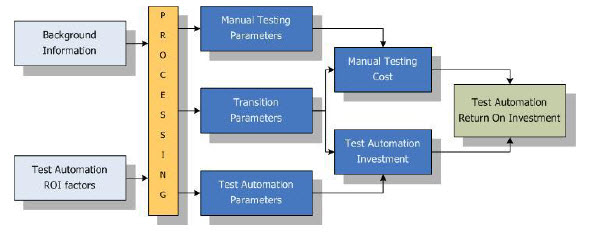
For a successful ROI computation, you need to have the existing test parameters of the product under test:
- Age of the product
- Releases planned for a year
- Number of existing regression test cases
- Number of configurations to be tested
- be tested
- Infrastructure cost
Apart from the above background information, the following parameters should also be considered:
- Test automation tool cost
- Percentage of test cases that can be considered for automation
- Time required for building reusable components, automation frameworks and batch scripts
- Hourly cost per test automation resource
The Automation Leap
The transition from manual to automated testing has a significant impact on the Test Automation ROI. It is an established fact that Automation involves higher upfront costs, but the optimal usage of this initial cost is very crucial in deciding the returns. The transition process must be a step by step process and has to be done by experts. The first step towards automation is to scope the automation requirements, analyze the technical feasibility for automation and identify an appropriate tool for automation. This will help you to estimate the required effort and cost for test automation investment.
When the estimation is being done, it is vital to consider the effort required for designing test automation framework, which will help you to use reusable components through out the automation and thus helps in reducing the script development time. These factors will help you to come up with a right estimation and you will be in a position to look at the real benefits of automation.
It is always worthwhile to understand and analyze the need for automation, analyze the product test requirements and the existing regression test suite, identify the right test automation tool and then estimate the timeframe required to design and automate the entire testing. This exercise would benefit in finding your potential automation ROI before investing in it.
A higher ROI will also come through with the following factors:
- Matured testing process
- Maximized test coverage which will assure the quality of the deliverables consistently
- Elimination of the risk of over sight of quality in repeated tests
- Faster Execution of the tests in multiple environments
- More focus on new features
- Enhanced product quality
Key Take Aways
Automation may not give you its benefits immediately. You would typically need ample time to transition your QA efforts from Manual to Automation. Moreover, you might have to continue to perform manual QA for certain aspects of your software. For medium to large sized software, you may begin to see the ROI only after 1-3 years, though this varies significantly across organizations.
After the break-even period, you will be getting a higher ROI due to the reduced test execution cost and effort. The returns can still be maximized by having disciplined set of processes during the transition phase.
Conclusion
Automation is a strategic investment and an understanding of the potential ROI will help you to make the right decisions. While automation does help in reducing the costs of testing, increasing test coverage and effectiveness, and shortening testing cycles, it may not be a silver bullet for all your quality control issues.


Lets Hang!