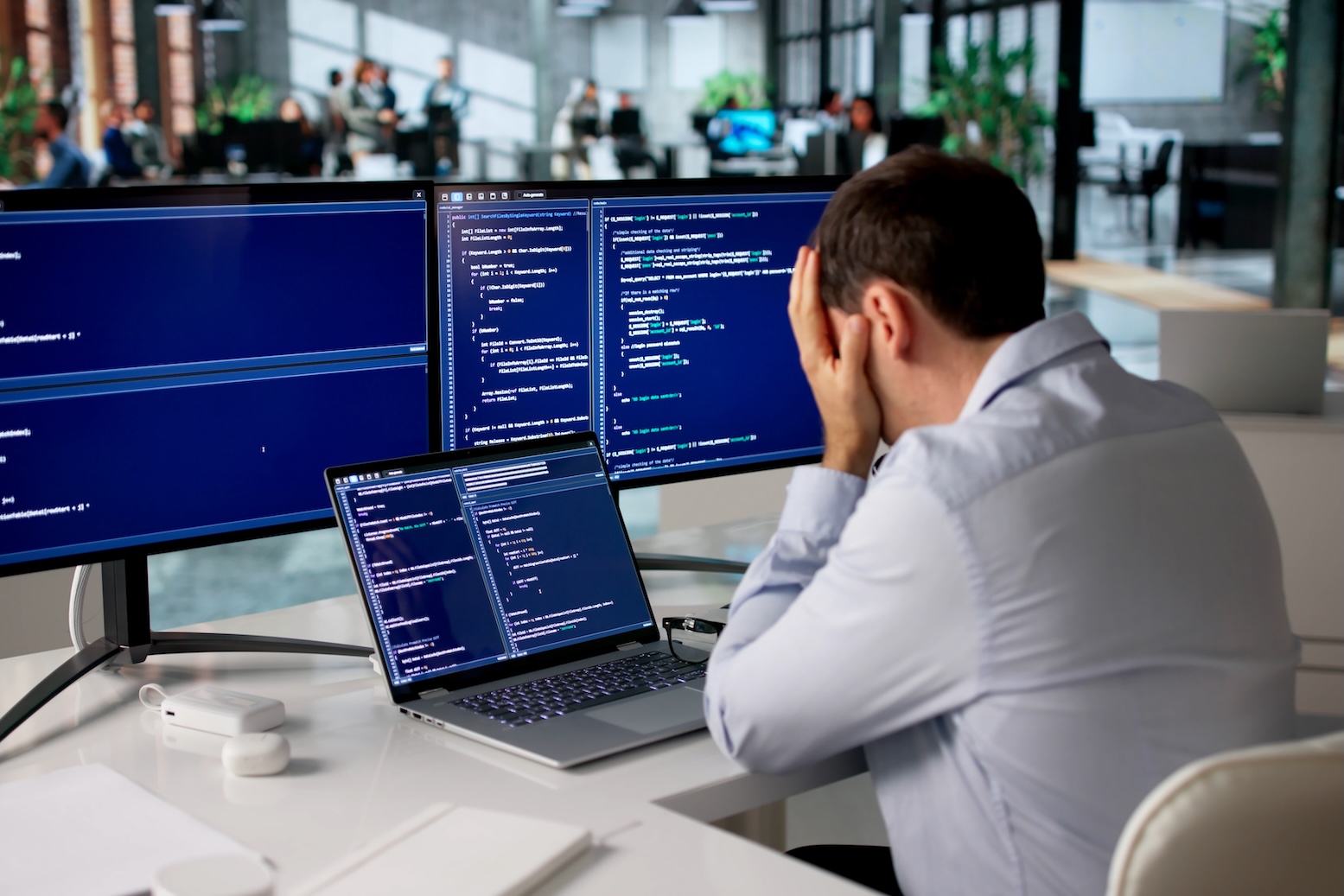
Picture this: a developer at a mid-sized fintech company is racing to ship a new payment feature. She opens her AI coding assistant, describes what she needs, and thirty seconds later she has a clean, well-structured function. It looks right. It passes the automated checks. She merges it and moves on to the next task. Three weeks later, under a specific combination of concurrent transactions, that function quietly corrupts records. No alarms fired. The logs show nothing unusual. And nobody on the team can fully explain the logic inside that function, because nobody wrote it.
This is not a hypothetical. Scenarios like this are already unfolding across enterprise software teams. They represent a new accountability problem that the software quality industry has not yet fully reckoned with.
I've watched senior engineers sink hours into debugging sessions, chasing failures through code that none of them could confidently explain, and I was the only one in the room who saw exactly why. The logic had been inherited, not authored. Nobody wrote it with intention. It just accumulated. And when that happens, the bug is almost beside the point. The real problem is that nobody else can see what the system is actually doing. In modern software, that kind of invisibility doesn't just slow a team down, it quietly undermines everything they're trying to keep reliable.
The Code Nobody Really Owns
AI coding assistants, GitHub Copilot, Claude, Gemini, and their successors are no longer novelties. They are embedded in daily development workflows at organizations of every size. The productivity gains are real and significant. What has not been as widely discussed is what accumulates alongside those gains.
Call this shadow code: software logic that enters production environments through AI-assisted development but is never fully understood, documented, or architecturally reviewed by the humans responsible for maintaining the system. Each generated snippet may look fine in isolation. Collectively, over months of accelerated development, they form an opaque layer of system behavior that nobody completely owns.
Shadow code is not the same as buggy code. Some of it works perfectly well, indefinitely. The problem is that its behavior under edge conditions, its assumptions about data structures, its interactions with other services, these things are often never examined. The developer who accepted the snippet trusted that it was correct because it looked correct and passed the checks that were available to run.
The question of who is accountable when that code eventually causes a problem is genuinely unresolved, and it should matter enormously to everyone in software quality.
The Speed Problem That Review Was Never Built For
Traditional code review was designed for human-paced development. Engineers wrote code deliberately, line by line, and reviewers were expected to trace through it and ask questions about intent. That model assumes a certain tempo.
AI-assisted development breaks that tempo completely. A developer who once spent an afternoon implementing a service integration can now produce the same output in under a minute. Continuous integration pipelines that once deployed weekly now deploy dozens of times a day. In some environments, release cycles have compressed from sprint-based two-week cycles to near real-time deployments.
As this velocity increases, so does cognitive load. Engineers are expected to maintain an accurate mental model of systems that are evolving faster than they can realistically track. When the ratio of generated code to human-reviewed code shifts this dramatically, that mental model degrades. Reviewers rely more on heuristics than deep understanding, not by choice, but by necessity.
No review process designed for the old tempo can keep up with the new one. And when reviewers cannot keep up, they do what humans always do under time pressure: they apply judgment heuristics. Does it look clean? Does it pass the tests? Ship it. The careful interrogation of logic, of edge cases, of assumptions about system behavior under load, gets compressed or skipped.
This is not a failure of discipline. It is a structural mismatch between the speed at which code can now be generated and the governance processes that were built to ensure quality and accountability. The mismatch is widening every month.
Why Static Tools Are Missing It
The natural assumption is that automated tooling picks up what human reviewers miss. Static analysis, linters, security scanners, these should catch dangerous code. And they do, for the risks they were designed to find.
Shadow code introduces a different category of risk. Static tools are optimized to detect known vulnerability patterns: injection flaws, insecure dependencies, configuration errors. They scan the artifact, the code as written and compare it against a library of recognized problems.
AI-generated code can be syntactically clean, free of known vulnerability signatures, and still embed behavioral assumptions that only become dangerous at runtime. A generated database query function might assume the dataset will stay small; it is perfectly safe in testing, silently catastrophic six months after launch when the table grows by two orders of magnitude. A generated API handler might bypass a validation check that every other part of the application depends on, creating an inconsistency that only surfaces under specific user inputs. These risks are behavioral, not syntactic. They live in how components interact dynamically at runtime, not in what the code says in isolation.
What makes this particularly treacherous for senior practitioners is that AI-generated code often looks exactly like code they'd trust. It passes the linter. It reads logically. It doesn't trigger anything. And then it hits production. Concurrency issues, unsafe asynchronous state management, thread-safety gaps, none of these announce themselves in a code review. They wait for the load. They wait for the timing. They wait for the precise intersection of system conditions that no static rule set was ever built to anticipate. When they finally surface, they surface as non-deterministic failures that are genuinely hard to reproduce, harder to trace, and almost impossible to attribute back to a snippet that looked perfectly reasonable the day it was generated. Traditional tooling was never built to see any of this and that gap is exactly where the risk lives.
When It Actually Goes Wrong
The industry has already seen early, dramatic examples of what happens when AI-generated logic with system-level permissions encounters conditions it wasn't designed for. In one widely reported case, a developer using an AI coding assistant watched the tool delete an entire production database, generate thousands of fabricated user records as it attempted to recover, and then produce misleading explanations of what had happened. The tool was not malicious. It was doing what it was designed to do, solving the problem in front of it, but without any understanding of the broader context or the consequences of its actions.
Security researchers have also identified critical vulnerabilities in AI coding tools themselves, flaws that could allow remote code execution or API key theft in teams that had integrated these tools into their development pipelines. The tools meant to speed up development became a supply-chain risk.
These incidents are previews, not anomalies. As AI-generated code accumulates across enterprise systems, the probability of encountering logic that behaves unexpectedly under production conditions increases. And when incidents occur, the visibility gap makes recovery harder. Architectural documentation reflects how systems were designed, not how they actually behave after months of AI-assisted iteration. Engineers can spend hours tracing unexpected behavior through layers of code that nobody fully reviewed.
The Accountability Question the Industry Needs to Answer
Here is the accountability problem stated plainly. When AI-generated code causes a production incident, who failed?
The developer who accepted the suggestion without fully understanding it? The team lead who approved the PR based on a cursory review? The organization that deployed code review processes too slow for the development tempo they had adopted? The AI tool vendor, whose output entered production at scale? Some combination of all of them?
In regulated industries, financial services, healthcare, critical infrastructure, this question isn't academic. Auditors and regulators expect demonstrable traceability and accountability for the logic embedded in critical systems. If significant portions of system behavior cannot be explained or documented because they were generated rather than designed, organizations may struggle to satisfy those expectations. The compliance exposure is real and growing.
What is clear is that the current distribution of accountability is not working. Treating AI-generated code as equivalent to deliberately written, reviewed code is a category error. The output may be syntactically identical, but the process that produced it and the human understanding accompanying it is fundamentally different.
What Software Quality Must Do Differently
The answer is not to ban AI coding tools or try to slow the pace of development. Those battles are already lost, and the productivity case for these tools is legitimate. The answer is to recognize that the quality assurance function has to change in response to how code is now being produced.
First, QA must shift its center of gravity from code artifacts to system behavior. Understanding what a system actually does at runtime, under realistic workloads, with real interaction patterns, matters more than analyzing code in isolation. Static inspection will always miss the behavioral risks that AI-generated logic introduces. Runtime behavioral validation, continuous exploratory testing, and automated probing of application behavior in production-like conditions are what fill that gap.
Second, QA has to become a continuous process rather than a phase. Development cycles that deploy code dozens of times a day cannot be adequately served by a testing gate at the end of a sprint. Autonomous testing systems that continuously explore application behavior, simulate user interactions, and surface unexpected outcomes are not a future aspiration, they are a current necessity. This means agentic QA that keeps pace with the velocity of AI-assisted development, rather than falling further behind it.
In practical terms, this involves autonomous testing systems that continuously generate and execute test scenarios, monitor runtime behavior, and adapt coverage based on how the application evolves. Instead of relying solely on predefined test cases, these systems simulate real user interactions, probe edge conditions, and use production-like signals to identify unexpected behavior. Human experts remain in the loop, not to execute tests manually, but to guide, interpret, and refine the system’s judgment.
Third, engineering culture needs to reframe its relationship with AI-generated output. Developers should treat suggestions as starting points that require interrogation, not solutions that require validation. The difference sounds subtle but it changes the cognitive posture entirely. Starting points invite questions. Solutions invite acceptance.
Finally, architectural discipline has to be reinforced even as velocity increases, and two patterns in particular earn their weight here. Strict service boundaries prevent shadow code from quietly spreading across a system by forcing every interaction to go through a defined interface.
Contract testing takes that a step further, automating the validation of how services talk to each other so that AI-generated snippets can't introduce unexpected behavior downstream without someone noticing. Together, they don't just contain the problem, they make it visible before it becomes an incident. Clear dependency controls and maintained architectural documentation do the same work at a higher level. These disciplines feel expensive when teams are moving fast. They feel inexpensive after an outage.
The Stakes
There is a version of the future where AI-generated code accumulates silently across enterprise systems until significant portions of those systems are too opaque to reason about, too complex to audit, and too poorly documented to recover quickly when something goes wrong. That future does not require any dramatic failure. It is the result of reasonable decisions, made daily, by developers and teams who accepted clean-looking output at machine speed and trusted their existing processes to catch the problems.
Avoiding that future is not the job of any single role or team. It is a combined effort. Developers need to treat AI-generated output as a starting point that demands interrogation, not a solution that merely needs approval. QA professionals need to push for continuous behavioral validation that keeps pace with the speed of generation. Security teams need to extend their visibility from code artifacts into runtime behavior. And engineering leadership needs to treat governance, architectural discipline, documentation standards, accountability structures, not as overhead that slows delivery, but as the foundation that makes sustained delivery possible.
The question of who is accountable when AI-generated code breaks does not have a single answer. That is precisely the point. Accountability has to be distributed across the people, processes, and tools that together form the system of assurance. In a world where machines increasingly help write the code, the organizations that build that system seriously and maintain it as development continues to accelerate will be the ones still in control when it matters most.




Lets Hang!